

EXOPLANET TRANSITS: MISSIONS
Find an exoplanet transit to observe
Select a region below and choose an event visible from your location.
Scroll down to see our Featured Transit Observation!
To find events tailored to your specific location, use the Scientific Events Prediction Page.
To find out if you can observe an exoplanet transit, simply select a row and zoom by scrolling on the map. If you are near any location with a symbol, you are qualified for that scientific mission! If there is not a symbol near your location, you will not be able to observe the event.
Each symbol has a meaning:
- Blue stars & shading = you can observe the entire event.
- Yellow triangles = you can observe the entire event but you may have temporary tracking difficulty when the star passes almost directly overhead (high altitude).
- Orange diamonds = you may miss the start or end of the event. These observations are still valuable!
You can click on any symbol for precise local observation times, target altitudes, and Sun altitudes.
Reading the Prediction Table:
- The Link automatically populates observing settings into the Unistellar app’s “Exoplanet transits” Science menu.
- Finder is an image of the target field of view. It may be rotated in your sky.
- Date is the observation start date in UTC (Coordinated Universal Time)
- Start, End UTC is the event’s observation start or end time in UTC. Your local start or end time may differ.
- Local is the observation start time in the time zone of your device’s browser.
Featured transit for February 2026:
TOI 5571.01
Help us determine the period of a TESS planet candidate!
Observation dates: February 13-14
Visibility: Europe, Africa, East Asia, Middle East, Japan
TOI 5571.01 is a planet candidate discovered by NASA’s planet hunting satellite, TESS (Transiting Exoplanet Survey Satellite), that orbits a star slightly hotter than our Sun nearly 1000 light years away from us. This particular gas giant planet might be very similar to our own Jupiter, since estimates suggest that it’s only a 1.08 times Jupiter’s diameter!
\
However, TESS only observed two transits of TOI 5571.01, once in 2020 and again in 2022. These transits were 731 days apart, but that doesn’t mean that the orbital period (how long it takes the planet to orbit its parent star) is quite that long. TESS could have missed some transits in between the two it saw, since it wasn’t looking at the host star constantly. To calculate other potential periods, astronomers take the 731 day “longest possible period” and divide that by integer values. These are called “period aliases”. For example, a period alias of P/2 means we divide 731 by 2 to get a potential period of 366 days. That is just one alias, and would mean that TESS only missed one transit in between the times it observed.
\
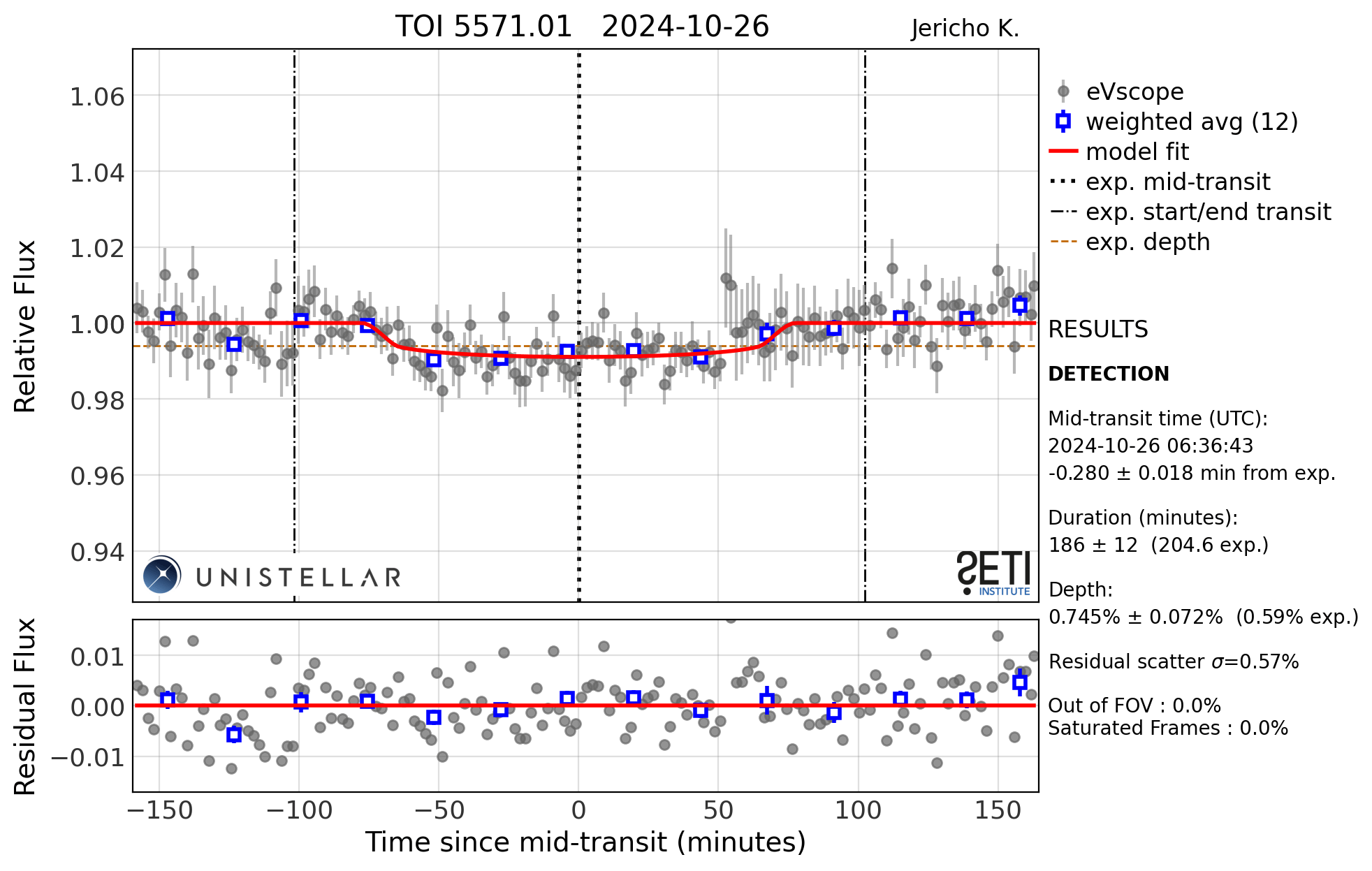
Previous observations, like the one above by Jericho K., show that the period might correspond to P/5, P/10, P/15, or P/20. This month, we have one of our last chances to observe the P/20 alias — corresponding to a 37 day period — until TOI 5571.01 starts to disappear until around September. Analysis shows that P/20 could reflect the true orbit of this candidate, so observations are incredibly important this February!
\
This transit occurs the local night of February 13-14 for all locations that can observe it. Observers in Japan and East Asia can catch the beginning of the transit, while observers in Europe and Northern Africa can catch the ending. The entire transit will be visible from India! Data from all viable locations will be crucial in this endeavor. See the globe video below to plan your observation!
How you can help confirm a TESS planet candidate :
Check the video below or in the tables above to see if this potential planetary transit will be visible to you!
- Once you have planned when you can observe, you must have the right observing settings or use a deeplink. You can use the deeplink below to observe for the entirety of the transit window. Or you can input the row’s recording settings manually to break your observation into one-hour increments by editing the “Duration” setting (this may improve your telescope’s tracking).
- Deeplink for full observation
- Observing settings: Gain = 22, Cadence = 3970ms, Exp Time = 3970ms, RA = 07h 07m 58s, Dec = +60deg 00′ 42”
- We need all the data we can get on this target! So if you can only get ingress or egress data, please still observe.
- Lastly, when you are done observing for the night, please submit this short REPORT FORM so we know to process your data.
If this is your first time observing an exoplanet transit, first check out our Exoplanet Tutorial page for an overview of the techniques involved. If you have any questions, please reach out to us at citizenscience@unistellaroptics.com.
Above: A video of the globe detailing the visibility of February’s transit of TOI 5571.01. When your location is shaded in red, the target is > 25 degrees above the horizon and visible to you.
New here?
Head to our Tutorial page linked below for guidance on how to master your Unistellar telescope and become a Planet Hunter. If you have any questions please contact us at citizenscience@unistellaroptics.com.