

SETI Institute + Unistellar Citizen Science
UNITE
Unistellar Network Investigating TESS Exoplanets
A NASA Citizen Science project

Use Your Telescope To Confirm The Existence Of Newly Discovered Worlds
Join the worldwide Unistellar Network of citizen scientists and professional astronomers to discover and characterize some of the most interesting exoplanets in our galaxy!
Giant exoplanets resembling Jupiter that have been recently discovered by TESS, NASA’s current exoplanet hunting mission, need your help. Astronomers don’t have enough information to fully understand the orbits of these planets, which take months or years to circle their star once. This is usually because TESS and other telescopes haven’t had many chances to catch the temporary dimming of the exoplanet’s star as the planet passes, or transits, in front it.
This is where you and UNITE come in! Only a network of people around the world, cooperating to observe the same target, will be able to catch more transits by these exoplanets.
This can be because these planets take many hours to transit their star (much longer than a single night on Earth) or because the dates of future transits cannot yet be accurately predicted. With your observations, scientists can understand the orbits and conditions of these foreign worlds like never before.
Explore below to learn about exoplanets or get started tonight!
Learn About Exoplanets
Get Started
Pick Your Target
Results
Featured Transit for August 2026
TOI-4153b

Image Credit: NASA Exoplanet Archive
Observation dates: August 22 UTC
Visibility: North America, Europe, Western Africa
Observe a hot Jupiter exoplanet!
TOI-4153b is a gas giant planet like our own Jupiter, but it orbits much closer to its star — a year on this planet takes only 4.6 days! This planet was discovered in 2024, but teams are still taking measurements to characterize the system in preparation for upcoming space missions. We’ll observe a transit of TOI-4153b on August 22 (UTC) in conjunction with a professional observatory to contribute important transit data to the community!
Featured Result: TOI 4465.01
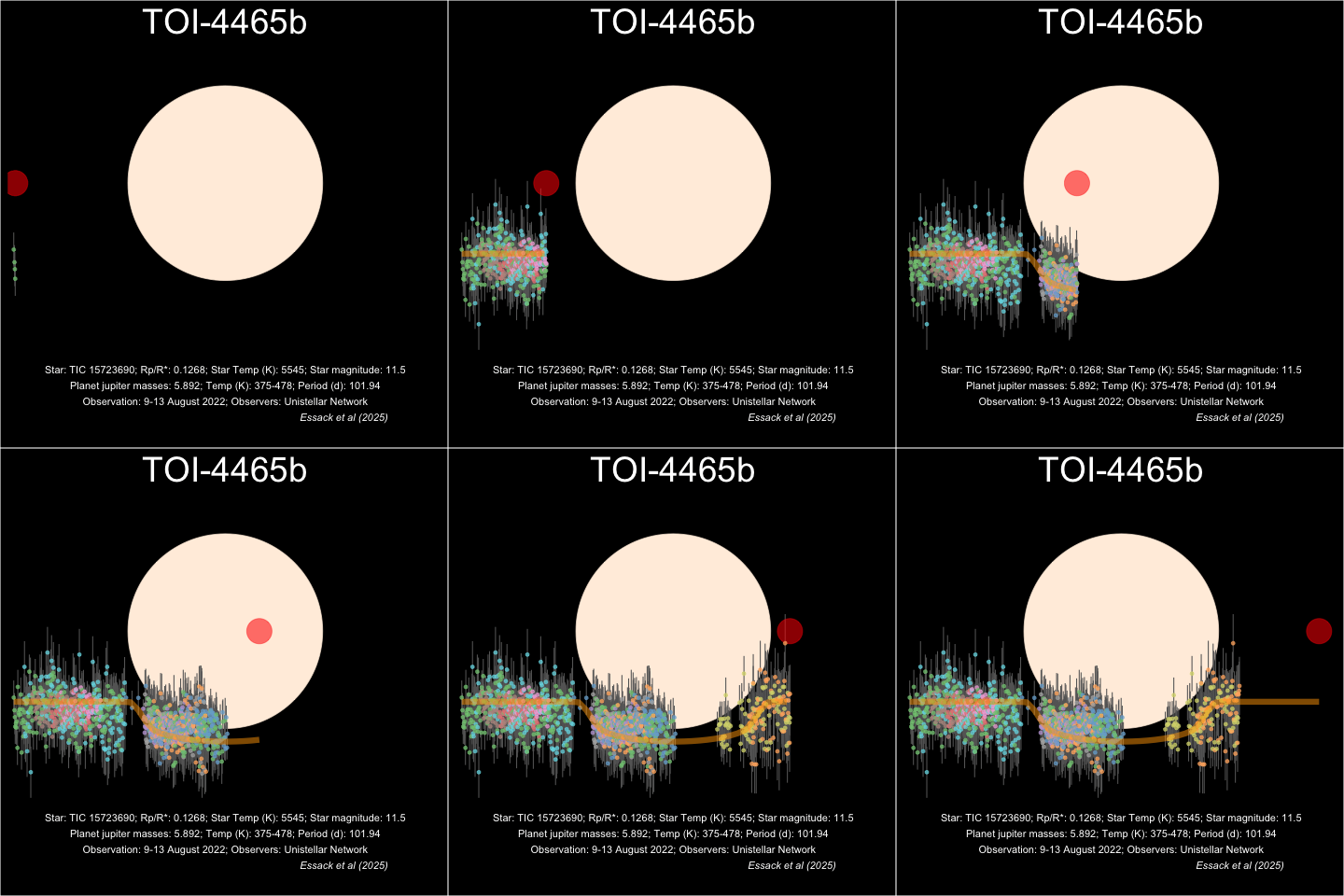
In August 2022, 24 UNITE Citizen Astronomers from around the world joined forces to track TOI-4465 b, a massive Jupiter-like planet about 400 light-years away. First spotted as a single transit in TESS data, its orbit was uncertain until this global campaign gathered 46 datasets across three nights, confirming that the planet circles its Sun-like star every 102 days. TOI-4465 b is unusually dense—six times Jupiter’s mass but only slightly larger—and represents a rare “temperate Jupiter,” offering astronomers a valuable new world to study. All observers are co-authors on the scientific paper detailing these results, led by Dr. Zahra Essack at the University of New Mexico, which you can read here: https://iopscience.iop.org/article/10.3847/1538-3881/add88b
Don’t have a Unistellar telescope? Here’s how you can still be part of the UNITE mission.
- If you have a different telescope + camera setup capable of recording images, our target predictions also apply to you! We invite you to observe them with us; however, we cannot process your data. For how to do that yourself, we recommend you visit the NASA Exoplanet Watch website and email Lauren Sgro at Lsgro@seti.org with your data or questions. You might also want to check out the TESS Follow-up Observing Program and American Association of Variable Star Observers, with whom we collaborate.
- If you don’t have an imaging telescope:
- Follow our latest news on the SETI Institute’s website & social media: Twitter, Instagram, Facebook
- Check in monthly with our Results page for updates on our priority exoplanet targets
- Community College students, professors, and friends: Ask if your college has a Unistellar telescope through the Unistellar College Astronomy Network (UCAN). If not, have the college’s astronomy professor contact UCAN’s director, Ian Weaver (iweaver@seti.org), to inquire about joining.
- Check out some of the other exciting citizen science projects supported by NASA!
Meet the Team
Meet the SETI Institute scientists behind the Unistellar Network’s NASA-Sponsored Exoplanet Programs:
Tom Esposito, PhD – UNITE Principal Investigator, Pipeline Development
Lauren Sgro, PhD – Exoplanets Lead, Observation Planning, Data Analysis, Communications
Franck Marchis, PhD – Outreach, Communications
Previous contributors – Dr. Paul Dalba, Dr. Daniel Peluso