ASTEROID OCCULTATIONS: MISSIONS
Find an Asteroid Occultation Mission for your sky. Select a region below and choose an event near your location.
To find events tailored to your specific location, use the Scientific Events Prediction Page.
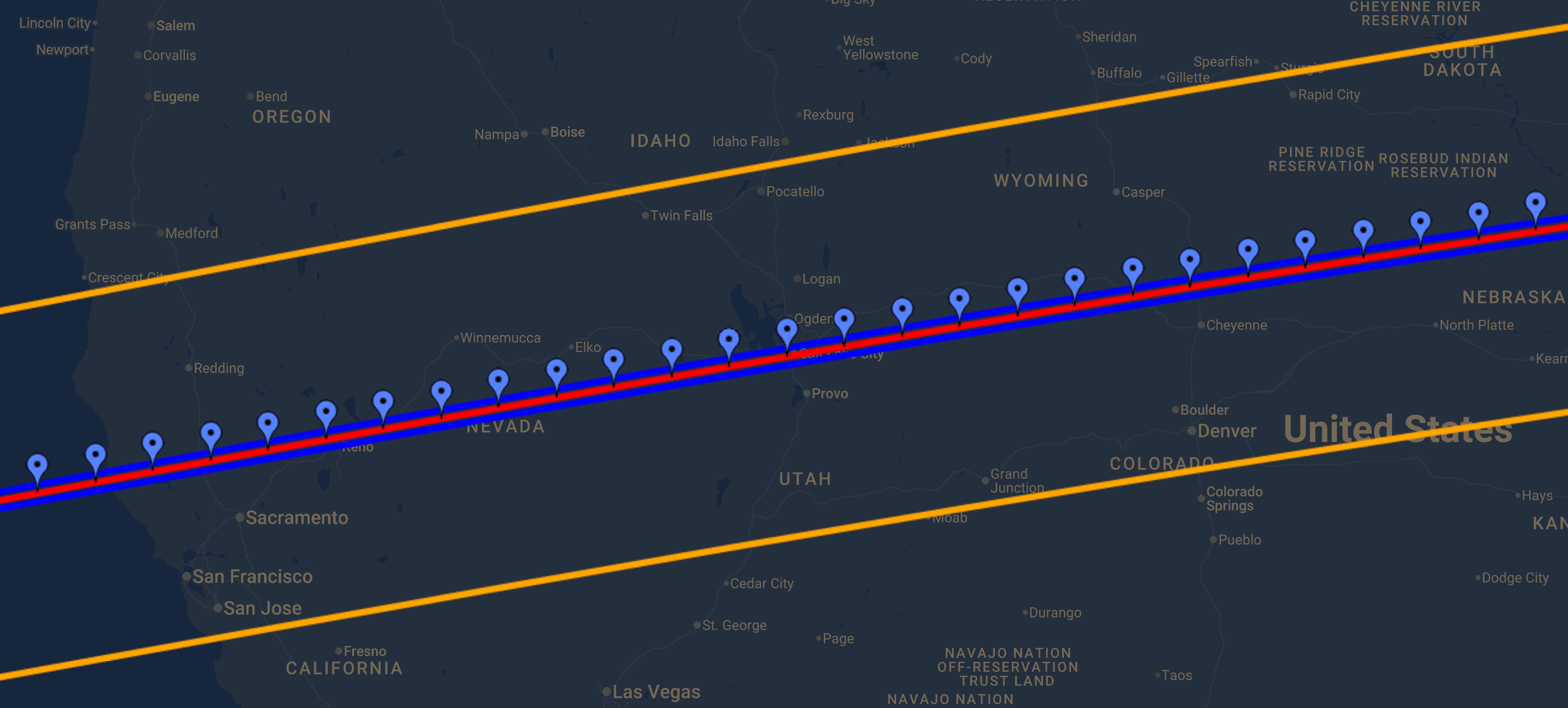
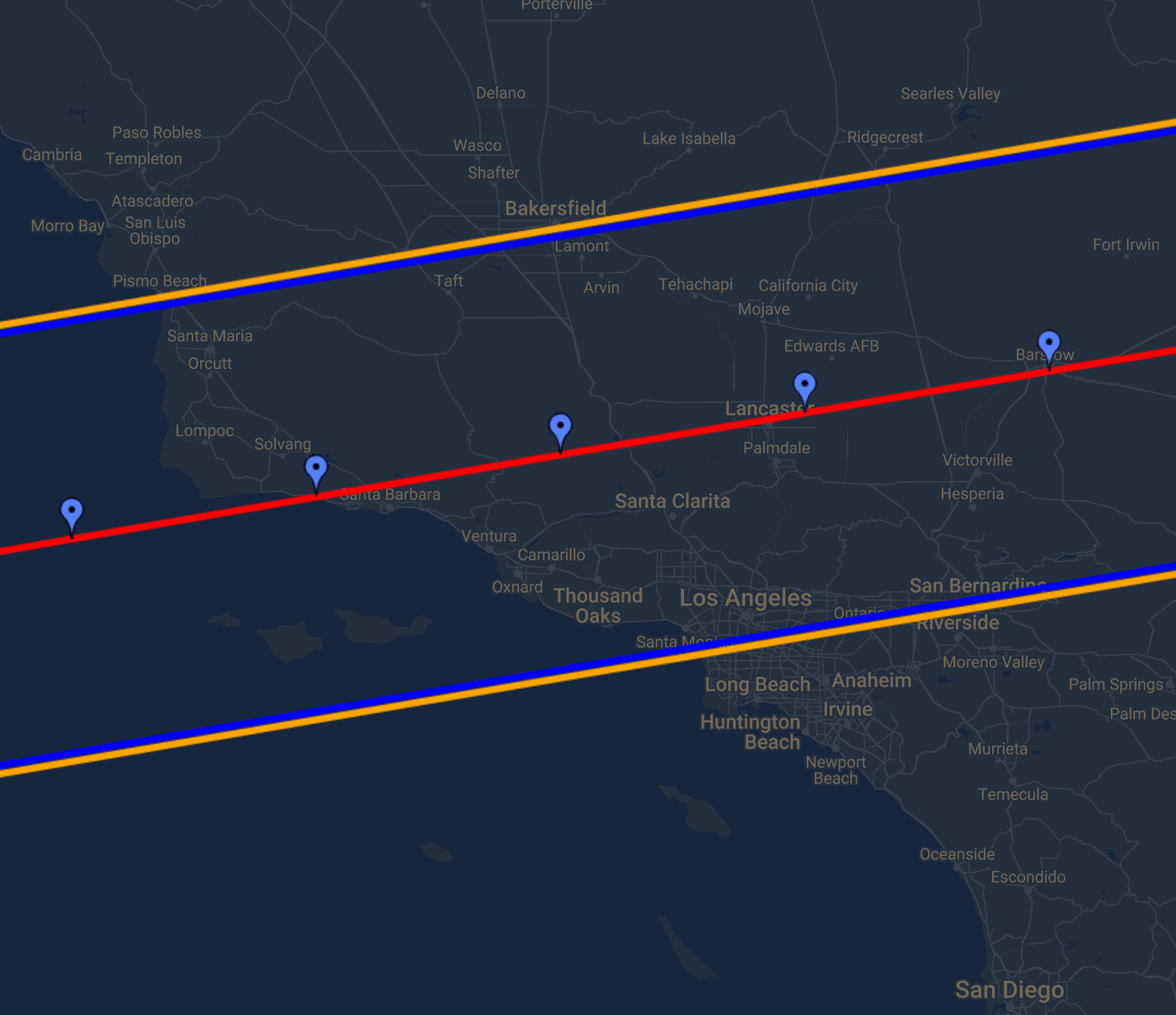
To find out if you will be in an asteroid’s shadow, simply zoom by scrolling on the map. If you are observing from anywhere between the two orange lines, you are qualified for the scientific mission! The closer you are to centrality, marked by the red line, the better chance you have of detecting the occultation.
Reading the Prediction Table:
- The Link automatically populates observing settings into the Unistellar app’s “Asteroid occultations” Science menu.
- Date UTC is the observation start date in UTC (Coordinated Universal Time)
- Time UTC is the event’s observation start time in UTC. Your local start time may differ (see next point).
- Local is the observation start time in the time zone of your device’s browser.
New here? Head to our Tutorial for guidance on how to master your Unistellar telescope to become a Shadow Hunter. If you have any questions, you can visit our Glossary Page, or please contact us at citizenscience@unistellaroptics.com.
Featured Occultation for August 2025
Asteroid 762 Pulcova and Its Moon
Here are the local times when to start the observations for the Pulcova’s moon in different time zones:
- Eastern Daylight Time (EDT, UTC−4) — e.g. New York, Washington DC
→ 2025-08-26 03:41 (EDT) - Central Daylight Time (CDT, UTC−5) — e.g. Chicago, Dallas
→ 2025-08-26 02:41 (CDT) - Mountain Daylight Time (MDT, UTC−6) — e.g. Denver
→ 2025-08-26 01:41 (MDT) - Pacific Daylight Time (PDT, UTC−7) — e.g. Los Angeles, San Francisco (and Reno)
→ 2025-08-26 00:41 (PDT)
And here is the universal Deeplink for the event:
On the early morning of August 26 (at 00:45 PDT or 03:45 EDT), asteroid 762 Pulcova will occult an 11.2-mag star, producing a 9 s drop as the main body’s shadow sweeps, for example, across northern Los Angeles — and beyond. Multiple observers spread across this track will each record a chord, and combining these chords will refine Pulcova’s size and shape far beyond what lightcurve inversions alone can achieve.
Pulcova’s moon, S/2000 (762) 1, is predicted to cause a brief 1.4 s dip, but its path is much less certain (roughly ten moon‐diameters at 1 σ). To detect that shadow, we will need several observers positioned across the satellite’s path (for example, over Reno or Salt Lake City). Do not hesitate to observe if you are within the orange lines.
We recommend exposure times of 300 ms for both the primary and secondary events to balance time resolution and signal-to-noise. All submitted data will be quickly processed by our pipeline and used for shape reconstruction. If we detect the satellite’s position, we will refine its orbit.
Find your observing parameters for both Pulcova and its satellite on our Prediction page (Prediction) and learn how to conduct the observation on our Tutorial (Tutorial). Let’s work together on August 26 to obtain Pulcova’s profile and pin down its moon’s orbit—science that rivals expensive VLT imaging without the enormous cost.
Event pages:
Pulcova (main body)
Past events in 2024
Concluded
Two Unistellar astronomers clearly observed the disappearance of the star, and one additional observation was positive. However, due to data quality issues, proper processing of the latter is currently too challenging. The remaining four observers were outside the predicted path, resulting in negative detections.
We have reported six of our observations to IOTA. The profile below displays all positive observations gathered so far by IOTA, with numbers 13 and 19 corresponding to Unistellar chords. The asteroid’s profile was well constrained, leading to a precise position determination. This will enable more accurate future predictions and also help refine the size estimate of the body.
CONTEXT: A transatlantic occultation by 2013 LU28 happened on Jan. 30 at roughly 01:53 UTC crossing, for example, Mexico, USA, Great Britain, France, Germany, Austria, or Croatia. It involved a G=12 magnitude star. The event can be as long as 2.8 sec.
This campaign was organized by our colleagues running the Lucky Star project. Here is a link to the campaign web: https://lesia.obspm.fr/lucky-star/occ.php?p=146068


Concluded!
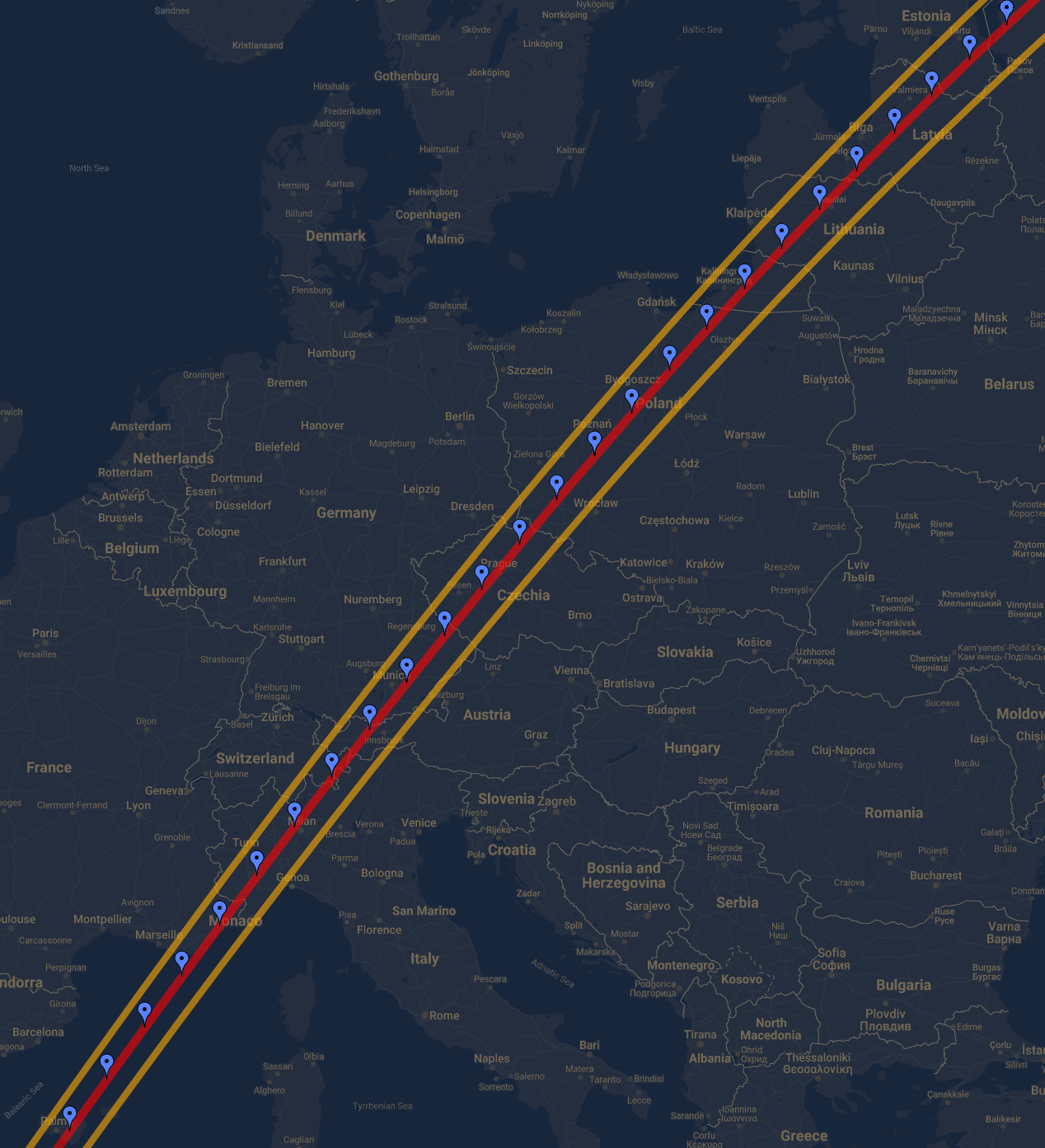
November is packed with exciting events! Another notable event will occur on the 16th at around 21:23 in France, Italy, Austria, Germany, Czechia, Poland, and the Baltic states, where a 9.9 magnitude star will be occulted by asteroid (438) Zeuxo for up to 6.3 seconds. This wide shadow path passes through many large cities (Nice, Milano, Innsbruck, Munich Prague) see the figures for details.
If you’re located within the shadow path, you can access the prediction on our Prediction page, where a deep link is also provided.
This is yet another great opportunity to gather multi-chord data. Note that the Moon will be disturbing the observations, thus locations outside heavily light-polluted areas are recommended.
Concluded!
November is packed with exciting events! Another notable event will occur on the 16th at around 21:23 in France, Italy, Austria, Germany, Czechia, Poland, and the Baltic states, where a 9.9 magnitude star will be occulted by asteroid (438) Zeuxo for up to 6.3 seconds. This wide shadow path passes through many large cities (Nice, Milano, Innsbruck, Munich Prague) see the figures for details.
If you’re located within the shadow path, you can access the prediction on our Prediction page, where a deep link is also provided.
This is yet another great opportunity to gather multi-chord data. Note that the Moon will be disturbing the observations, thus locations outside heavily light-polluted areas are recommended.
Concluded!
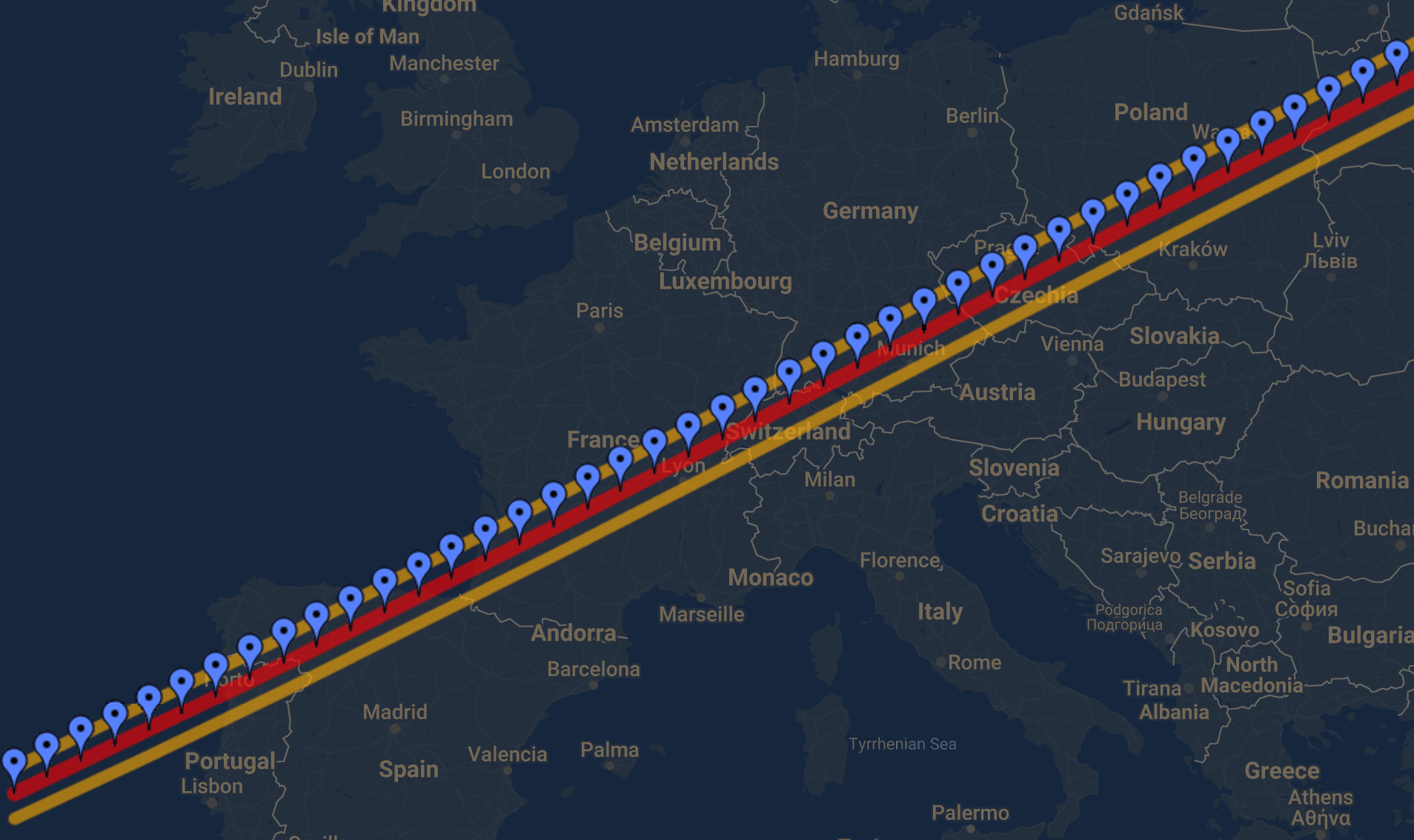
This November, European observers can observe also an occultation by the large Main Belt Asteroid (120) Lachesis! It will occur on Nov 13th at around 23:38 (CET) in Portugal, Spain, Italy, and Greece, where a 11.4 magnitude star will be occulted by (120) Lachesis for up to 36.5 seconds. This wide shadow path passes through many large cities—see the figures for details, where the path is encompassed by the yellow lines.
If you’re located within the shadow’s path, you can access the prediction on our Predictions page or by selecting your region in the table above. A deep link is provided with the prediction along with a zoomable map. Note that the observation will be affected by the almost full moon about 70 degrees away from the target.
One observations was obtained. TBD.

Concluded!
This November, European observers can observe an occultation by the large Main Belt Asteroid (207) Hedda! It will occur on Nov 9th at around 20:00 (CET) in Portugal, Spain, France, Switzerland, Germany, Czechia, and Poland, where a 9.1 magnitude star will be occulted by (207) Hedda for up to 5.7 seconds. This wide shadow path passes through many large cities—see the figures for details, where the path is encompassed by the yellow lines.
If you’re located within the shadow’s path, you can access the prediction on our Predictions page or by selecting your region in the table above. A deep link is provided with the prediction along with a zoomable map.
We obtained one positive detection in Czechia. Several other detections from observers outside Unistellar network => we will have a multi-chord profile. TBD.
Our Partners