

Above: NGC 7331, the sight of supernova SN2025rbs, imaged by George Gheirchi (US).
That’s a wrap on 2025! Every year, SETI Institute & Unistellar Network observers amaze us with their dedication to the skies above — and 2025 truly raised the bar.
In 2024, the Network submitted just over 10,000 citizen science observations, a fantastic feat that broke previous records. In 2025, that number jumped to more than 15,000 observations, making this our biggest year yet. Every scientific program grew, with exciting new opportunities across the board. We even launched a brand-new Satellites program, while comet observations more than doubled compared to the previous year.
From distant exoplanets to fragmenting comets and high-energy cosmic explosions, citizen scientists helped produce results that are pushing the frontier of what community-driven science can achieve. Let’s break it down by science case!
Exoplanet Transits
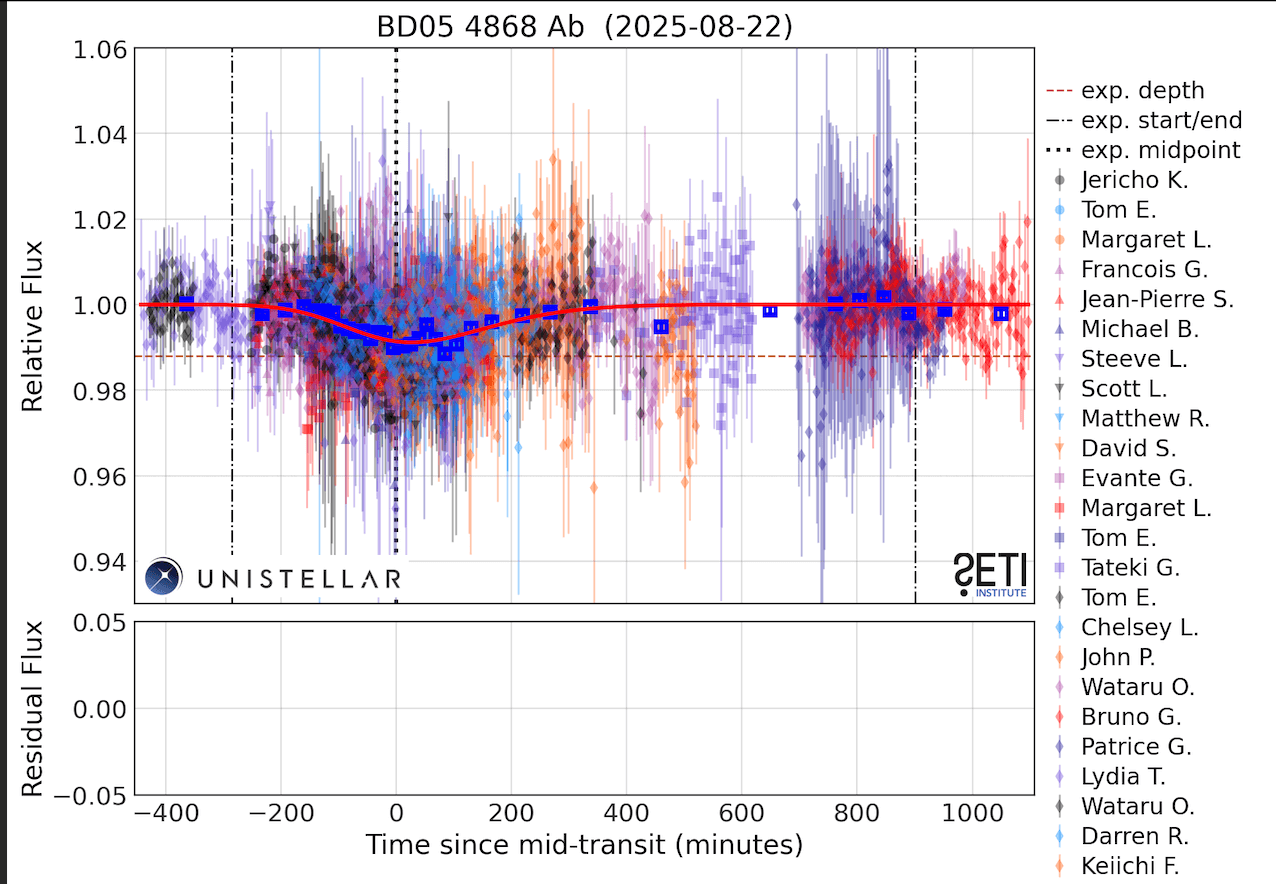
2025 brought a host of exciting new worlds into view through Unistellar telescopes. One particularly unique planet was BD+05 4868 Ab, a disintegrating planet discovered just last spring — and only the fourth known planet of its kind. Planets like this give astronomers a rare chance to study exactly what these melting worlds are made of, making observations critical.
In July and August, observers had four chances to catch BD+05 4868 Ab as it transited its star, alongside simultaneous observations by Keck Observatory. The Network successfully captured three of the four transits, revealing the planet’s bizarre, asymmetric transit shape caused by trailing tails of planetary material being stripped away along its orbit. These campaigns led to a new record for the community’s longest continuous observation… 25 hours!
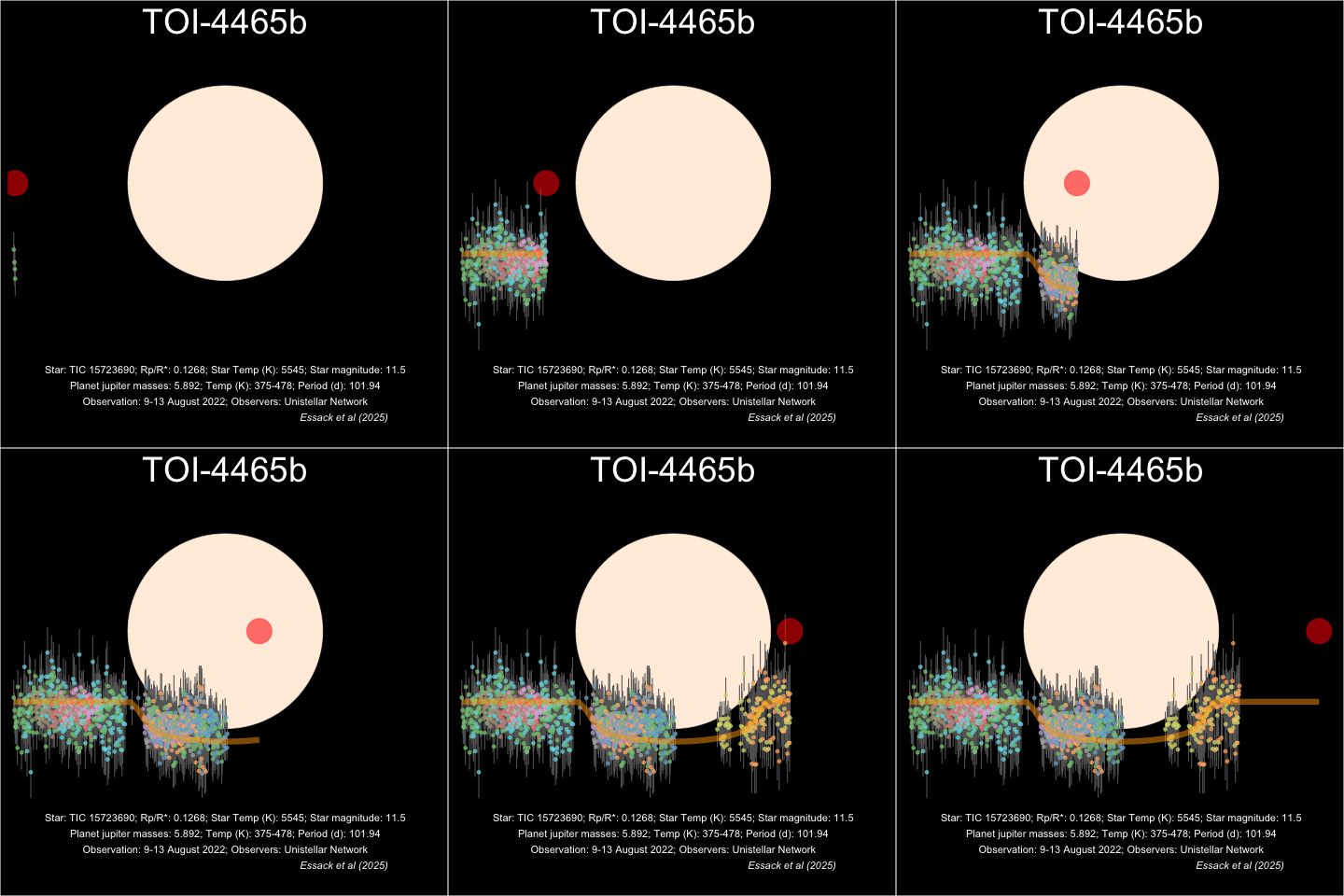
Disintegrating worlds weren’t the only success story. Citizen astronomers also helped confirm a brand-new exoplanet in 2025. In a study led by Dr. Zarah Essack (University of New Mexico), SETI Institute & Unistellar observers joined other citizen scientists to detect a ground-based transit of candidate planet TOI-4465 b. In total, 24 observers from 7 countries contributed data on TOI-4465b and are now co-authors on the study that locked down the planet’s orbit and confirmed its existence. Across all the exoplanetary events of 2025, 146 observers turned their telescopes toward other planets 1,465 times.
Cometary Activity
Last year was also packed with captivating cometary events. The year opened with a dramatic one: C/2024 G3 (ATLAS), nicknamed “The Headless Comet.” In January, the comet was bright enough to be seen with the naked eye — but after perihelion, it disintegrated completely, leaving behind a striking tail and no surviving nucleus. Thanks to months of coordinated observing, the Unistellar Network captured the full disintegration of this comet in unprecedented detail.
Later in the year came an interstellar visitor: Comet 3I/ATLAS, only the third known comet from outside our solar system to pass through our skies (and decidedly not an alien spacecraft). The Network began observations on July 4 and continues to observe it today. In 2025 alone, citizen astronomers collected 480 observations, even catching an unexpected brightening in October.
An interstellar guest wasn’t all that 2025 had to offer! Observers tracked the fragmentation of C/2025 K1 (ATLAS) nearly in real time, and also monitored the break-up of Comet 240P. Many citizen scientists were also published this year in a study of Comet Hartley 2, which the Unistellar Network observed throughout its entire 2023 apparition. Those observations revealed that the comet’s activity continues to decline — suggesting it may no longer qualify as “hyperactive.”
In total, 248 SETI Institute & Unistellar observers watched comets fly by our planet 2,826 times last year, especially during the Northern Hemisphere’s fall, when five different bright comets graced the skies!

The “headless comet” C/2024 G3, imaged by Darren Rivett (Australia).
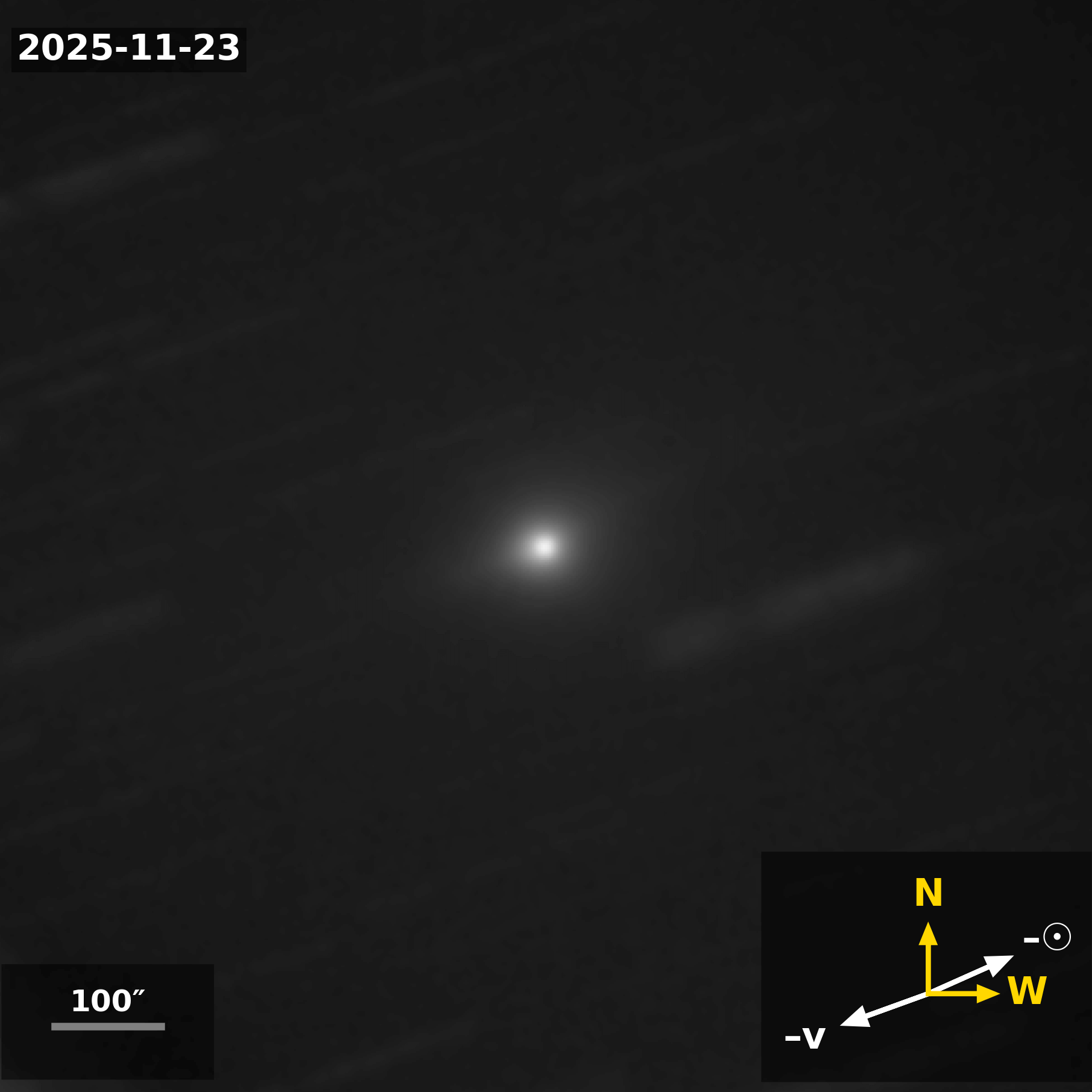
Comet 3/I ATLAS, imaged by Kevin Heider (US).
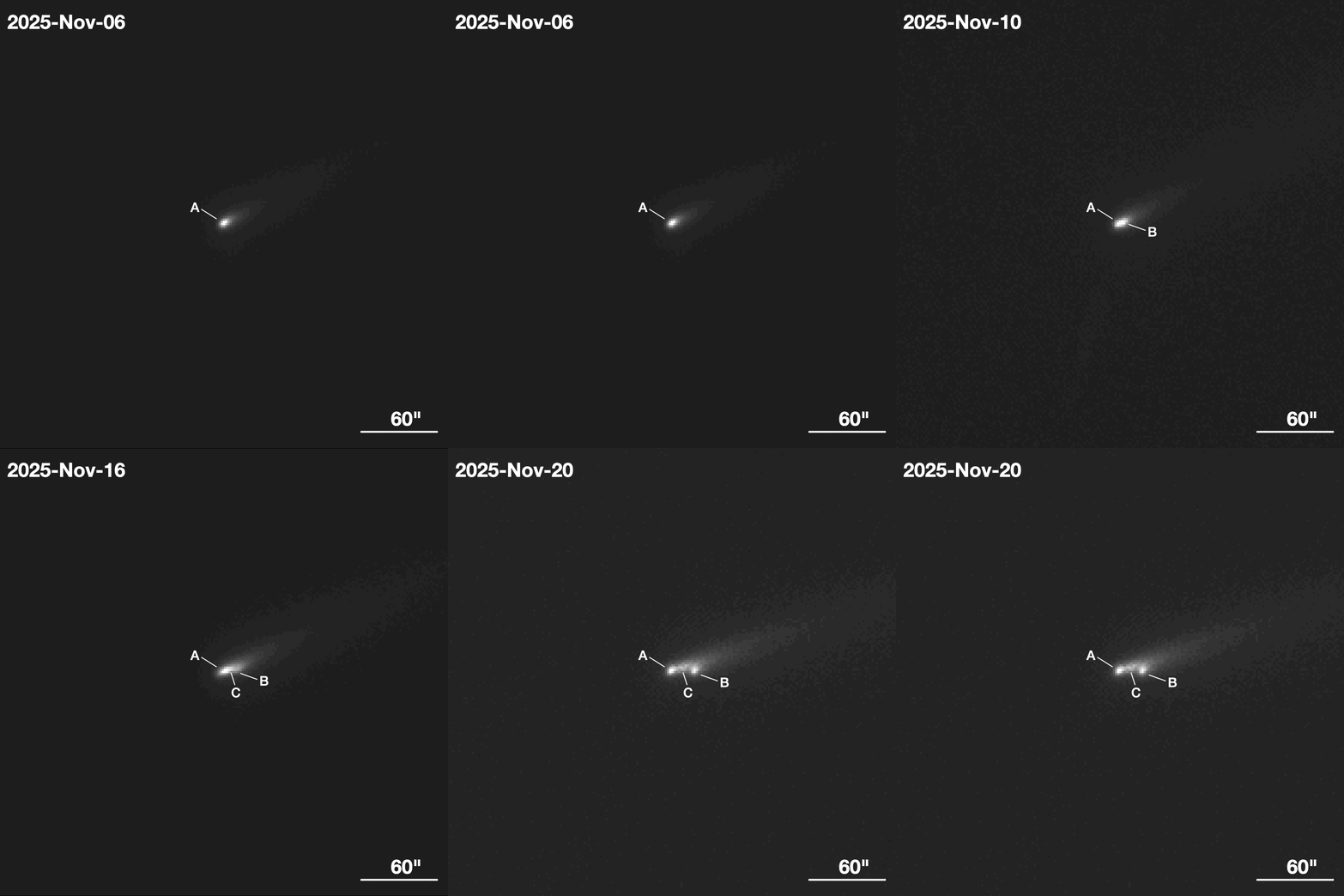
The fragmentation of Comet K1, captured by several citizen astronomers. The different fragments are shown as A, B, and C.
Cosmic Cataclysms
The Cosmic Cataclysms program, which is focused on high-energy events like supernovae, had an explosive year.
While observers are still patiently awaiting the long-anticipated eruption of T Coronae Borealis (with over 1,500 measurements collected in 2025 alone), other remarkable events took center stage. Take for instance Supernova SN 2025rbs, a Type Ia supernova in the stunning galaxy NGC 7331, roughly 15 million light-years away. Citizen astronomers observed this supernova more than 350 times, from peak brightness in July through its fade from view in November.
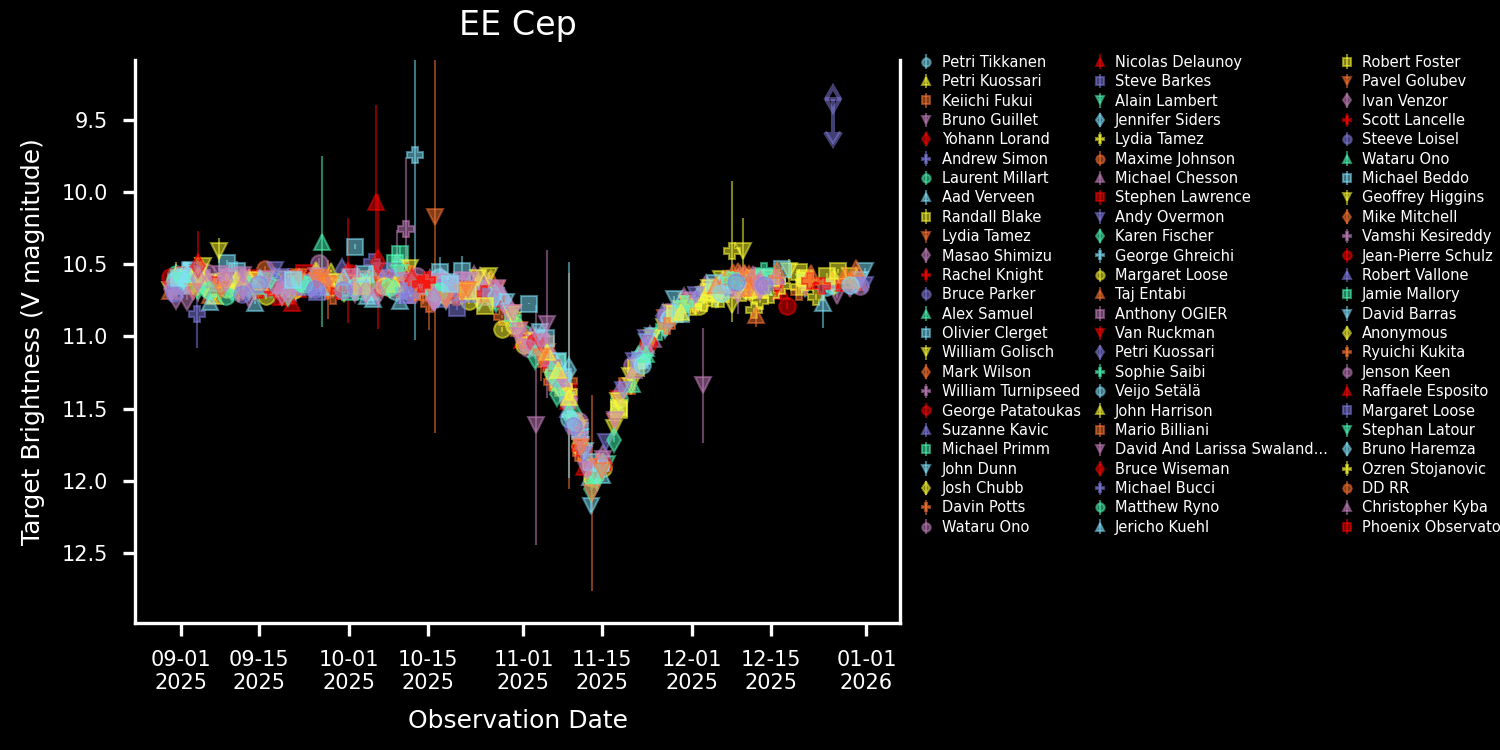
Among the 130 different targets observed in 2025 was EE Cep, a binary system in which one star’s dusty, circumstellar disk eclipses the other star every 5.6 years. Observers captured the entire event — from October 15 to December 11 — and gathered 670 datasets between August 30 and December 31. But even EE Cep’s data is just a drop in the bucket compared to the staggering total of 6,820 Cosmic Cataclysms observations that the over 220 community members made last year!
Satellite Surveillance
2025 marked the first official year of our newest citizen science effort, Satellite Surveillance, which delivered major milestones right out of the gate.
Observers tracked 840 different objects, including the Network’s first-ever observations of geostationary satellites, some of the most distant satellites from Earth. Two such targets, Shijian-25 and Shijian-21, were observed shortly after what appeared to be the first successful satellite refueling mission.
Closer to Earth, the Network pushed the limits by detecting its faintest low-Earth-orbit object yet: Saturnin-1, a tiny CubeSat just about a foot long — the smallest object ever observed by any of our citizen science programs. Observers also followed NASA’s solar sail mission ACS-3, tracking its deployment and rotation through changes in reflected light. Although NASA ultimately lost control of the spacecraft, this campaign marked a major first for the Satellites program.
To sum up a fantastic first year, the Satellites Surveillance program reeled in over 2,070 datasets from 90 observers! A special shout-out goes to Bryan Tobias, who made the most contributions of any campaign participant with an incredible 970 satellite observations in 2025.
Planetary Defense
Thanks to Unistellar Network data, astronomers built shape models for eight new main-belt asteroids in 2025. These asteroids were selected because they are relatively young (less than 10 million years old) and dynamically fresh. The broader goal is to understand how asteroid fragmentation — which creates these families — connects to meteorites that eventually reach Earth.
To support this effort, observers tracked 22 different asteroids during close approaches in 2025. One of these space rocks was asteroid Eros: observer Davin Potts captured its full light curve five times during the year, contributing valuable data on its spin so that astronomers can compare real-life data to models. All together, 165 observers watched 53 different asteroids a total of 1,604 times in 2025!

Asteroid Occultations
Asteroid occultations delivered some of the most exciting discoveries of the year. When an asteroid briefly blocks the light of a background star, citizen scientists can help determine its shape, size, and orbit with remarkable precision.
In one remarkable result, observer Van Ruckman (Virginia, USA) confirmed that asteroid (1626) Sadeya is a binary system. While earlier data hinted at a small companion, Ruckman’s observation definitively confirmed a secondary object with a minimum diameter of 3.9 km.
Another major success came from a transatlantic campaign targeting the trans-Neptunian object 2013 LU28. Citizen astronomers across the US, Mexico, and Europe submitted nine observations, including both detections and non-detections — all crucial for constraining the object’s shape and refining its astrometric position.
In total, 95 observers contributed 417 occultation observations in 2025 — an extraordinary demonstration of what coordinated citizen science can accomplish.

2026 in Full Swing
Although 2025 will be hard to beat, 2026 is already shaping up to be full of intriguing targets and findings. Observers in the Northern Hemisphere have continued tracking 3I/ATLAS as it fades beyond the reach of their telescopes, while also turning to new comets, like 24P/Schmaumasse, in January 2026.
The Unistellar Network even kicked off the new year by observing its first rocket bodies, or space debris. With additional exciting events on the horizon — from NASA’s Artemis II mission and a total solar eclipse to promising opportunities to confirm the nature of a suspected exoplanet — 2026 is already set to deliver a stellar lineup.
Thank you to all the citizen astronomers who spent late nights gathering crucial data throughout 2025. As we look ahead, we invite you to keep your eyes on the skies and continue discovering the universe with us.