

If you received an alert from the Unistellar App about T CrB, that means this nova may have exploded! Visit our Alerts Page to learn how to observe it!
Update March 2025
Since last year, astronomers have been waiting for the binary system T CrB to “go nova,” and the time for an explosion may be nigh. This February, astronomers noticed that the system’s accretion rate is increasing, meaning that the white dwarf that’s set to explode is receiving an influx of matter from its red giant companion. Because this pileup of stellar material is the assumed cause of T CrB’s recurrent explosion, the increased infall could mean that the nova is imminent. In addition, a recent Research Note proposes that the next event may happen March 27 or November 10 2025, based on the fact that the novae seemingly recur every ~127 orbits. Though possible that T CrB will explode by the month’s end, we still don’t know for certain when it will put on a show — even more reason to gather data now! More data leading up to the nova will help scientists deduce its cause when it does combust. And if it is truly going to explode soon… this is your chance to catch a cosmic cataclysm in action!
The American Association of Variable Star Observers (AAVSO) announced on Thursday, June 29, 2023, that a nova eruption is expected from a binary star system called T Coronae Borealis (T CrB) sometime between February and September of 2024. The star system is normally too faint to see without a telescope, but during the outburst it will be as bright as the North Star. Astronomers predict that after the peak brightness, the star will be visible for several days to a week with binoculars before fading again. Citizen astronomers can contribute to the study of this event by participating in the Unistellar Cosmic Cataclysm observing program, and be the first to see this rare explosion.
Visit the T CrB event page for our latest results and an observation deeplink.
What is a nova?
Novae occur in “cataclysmic variables,” which are simply binary star systems (two stars in orbit around each other) in which one of the stars in a white dwarf. A white dwarf is essentially a dead stellar core, and the T CrB binary system is made up of both a white dwarf and a red giant. White dwarf stars are extremely dense — they are roughly as massive as the Sun but only slightly larger than Earth, making them a million times denser than a normal star! Because their gravity is so strong, they can pull matter from the other star in the system. In the case of T CrB, the white dwarf accretes hydrogen from its red giant companion until the hydrogen reaches a critical limit and causes a runaway nuclear reaction on its surface, temporarily reigniting the white dwarf back to life. The nova eruption can eject a large amount of material from the white dwarf, which can be studied by astronomers to learn more about the properties of white dwarfs and binary star systems.
Why Observe T CrB?
T CrB is a well-studied nova system 3,000 light years away in the constellation Corona Borealis, and astronomers have been predicting its eruption for many years. In fact, T CrB produces a recurring nova — one of only five known in our galaxy — that erupts approximately every 80 years, making this a once-in-a-lifetime event. The upcoming eruption is a rare opportunity for astronomers to study a nova in detail from its early stages. By observing the eruption, astronomers can learn more about the physical processes that cause novae, as well as the evolution of binary star systems.
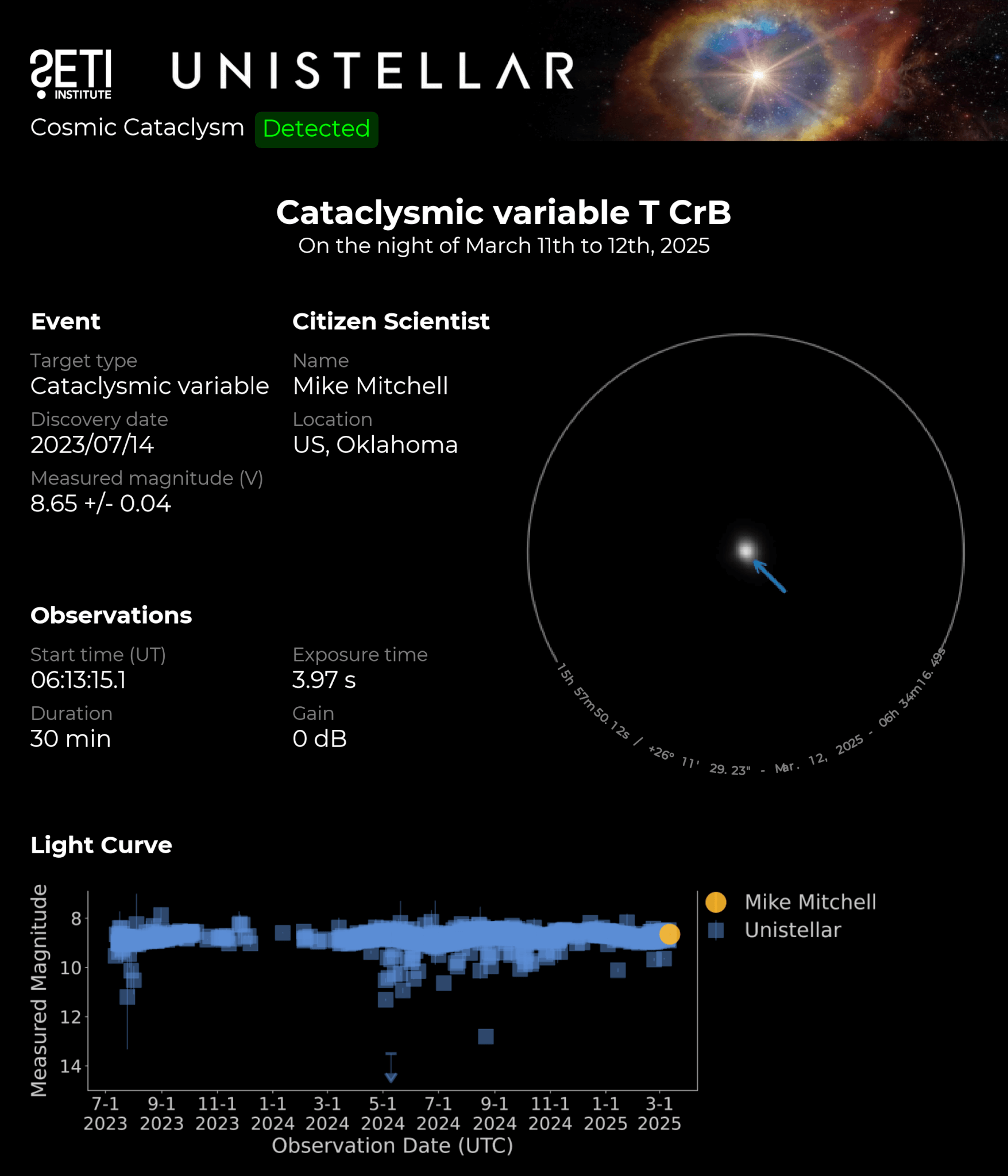
A report detailing Citizen Astronomer Mike Mitchell’s observation of T CrB on March 12, 2025. The light curve of all observers’ combined data is shown at the bottom. Observe T CrB through the Cosmic Cataclysms program for a similar report!
Join the fun and be the first one to detect this nova using your Unistellar telescope
The SETI Institute is inviting citizen astronomers to participate in its observing program called Cosmic Cataclysms, in partnership with UNISTELLAR, to help monitor T CrB for signs of an eruption. Participants are asked to take regular observations of the star system. If observers use a Unistellar telescope, their data will be processed a few hours after being uploaded on our server and analyzed so that we can trigger a worldwide alert if the nova is detected. This data will be used by astronomers to track the development of the eruption and to learn more about this fascinating phenomenon. Visit our Cosmic Alerts webpage and scroll to the “Highest Priority” section for observing instructions.
In addition to being a valuable scientific contribution, participating in the Unistellar Cosmic Cataclysm program is a great way for citizen astronomers to learn more about novae and perhaps be the first person to witness this rare event. To learn more about our Cosmic Cataclysm program designed in collaboration with Unistellar, visit our Cosmic Cataclysms webpage. This page will also instruct you on how to make observations with your UNISTELLAR telescope.