

It’s an electrifying time to be a solar observer. With the total solar eclipse gracing North America on April 8th and our celestial neighbor entering a phase of heightened activity known as a solar maximum, we are poised for a spectacular astronomical show. This phenomenon, occurring roughly every 11 years, is characterized by an uptick in magnetic regions and awe-inspiring solar flares on the Sun’s surface, set to reach its maximum around 2025. Let’s delve into the nature of these active regions, their potential effects on Earth, and how we can monitor them safely from the comfort of our backyards.
What’s Unfolding Above Us?
At its core, the Sun functions as a colossal magnetic powerhouse, referred to as a solar dynamo. While the intricacies of this process remain a hot topic of research, the dynamo causes the Sun’s magnetic field to undergo a polarity reversal approximately every 11 years, swapping the north and south poles. This reversal marks a period of intensified solar activity, manifesting as dark and bright regions, along with solar flares. Below is a brief overview of these phenomena and how Sun’s rotation affects them.
Dark Regions: Sunspots and Their Role in the Solar Cycle
Sunspots are areas of potent magnetic activity on the Sun’s photosphere, the layer of the Sun’s atmosphere that we think of as its “surface” and where most sunlight is emitted. These regions feature a central dark area (umbra) that can dwarf Earth in size, often encircled by a lighter penumbra. Originating at mid-latitudes, sunspots drift towards the Sun’s equator as the solar cycle progresses. Despite the umbra being the darkest part, its temperature can reach 3000 to 4500 K (2727 to 4227 °C; 4940 to 7639 °F), in stark contrast to the Sun’s surface temperature of about 5700 K (5427 °C; 9800 °F). Although less luminous than the surrounding surface, sunspots outshine the full Moon, illustrating the Sun’s immense power.
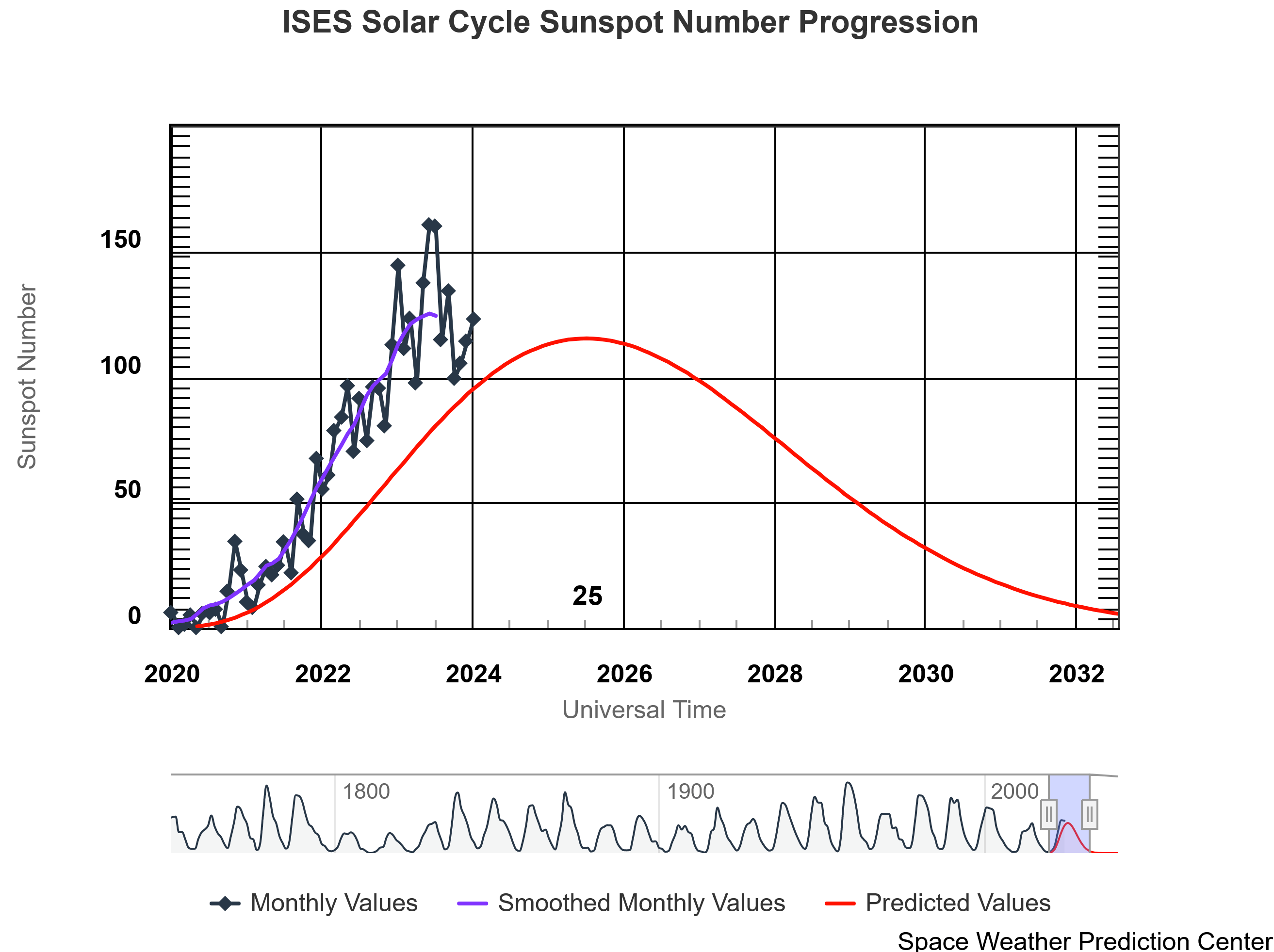
The solar cycle, a recurring 11-year sequence marked by a fluctuating number of sunspots, has been documented since 1843. We’re currently navigating Solar Cycle 25 (December 2019 – December 2030), anticipated to reach its maximum between 2023 and 2026. The accompanying figure, tracking sunspot activity over time, illustrates that we’re fast approaching this dynamic phase.
As we witness the Sun’s magnetic tapestry unfold, understanding and observing these solar maxima offer not only a glimpse into the mechanics of our universe but also a reminder of the Sun’s profound impact on Earth and beyond. Whether you’re an avid astronomer or a curious onlooker, the current solar cycle presents an unparalleled opportunity to engage with the cosmos in our own backyard.
Light regions: faculae and plages
Faculae are luminous magnetic phenomena within the photosphere that can extend into the chromosphere, the layer above the Sun’s photosphere that functions similarly to Earth’s atmosphere. When in the chromosphere, these features are termed plages, distinguishing them from their photospheric counterparts. Remarkably, these bright areas outnumber sunspots by about tenfold and also originate in regions with dense magnetic field lines. Although they often form near sunspots, their presence isn’t dependent on them. These magnetic marvels can exceed the Sun’s surface temperature by over 1,000 K, highlighting their intense heat and energy.
Explosions: Solar Flares and Coronal Mass Ejections
Solar flares are rapid, powerful bursts of electromagnetic energy erupting from the Sun’s surface. These flares primarily occur near sunspots, where the pent-up energy in magnetic fields is suddenly released into the corona, the Sun’s outermost layer. Flares unfold within mere minutes and can propel ionized material (plasma) alongside magnetic energy bursts in an event called a coronal mass ejections (CMEs). A single CME can eject over 10^12 kg of solar material into space, equivalent to twice the mass of New York City!
The Sun’s Rotation and its Effects
The Sun completes a rotation on its axis approximately every 26 days, with variations by latitude — the Sun spins faster at the equator and slower at the poles. Considering Earth’s orbit, this equates to about 28 days from our perspective at the equator. Active regions passing through the Sun’s central viewpoint from Earth are optimally positioned to launch CMEs directly toward us.
Rotation of the Sun over the course of one day. Courtesy of NASA/SDO and the AIA, EVE, and HMI science teams.
Earthly Impacts
Solar activity fluctuations significantly affect Earth. A notable instance occurred in 1989 when a massive CME disrupted Quebec, Canada’s power grid, triggered geomagnetic storms, and intensified auroras visible as far south as Cuba. Moreover, solar flares and CMEs can jeopardize satellites, necessitating temporary shutdowns, and endanger astronauts, who must seek shelter from these space weather events. X-class flares, the most energetic although infrequent flares, can cause disruptions such as these. The most potent X-class flares in six years erupted on February 21st of this year, luckily without accompanying CMEs, leading to minor radio blackouts.
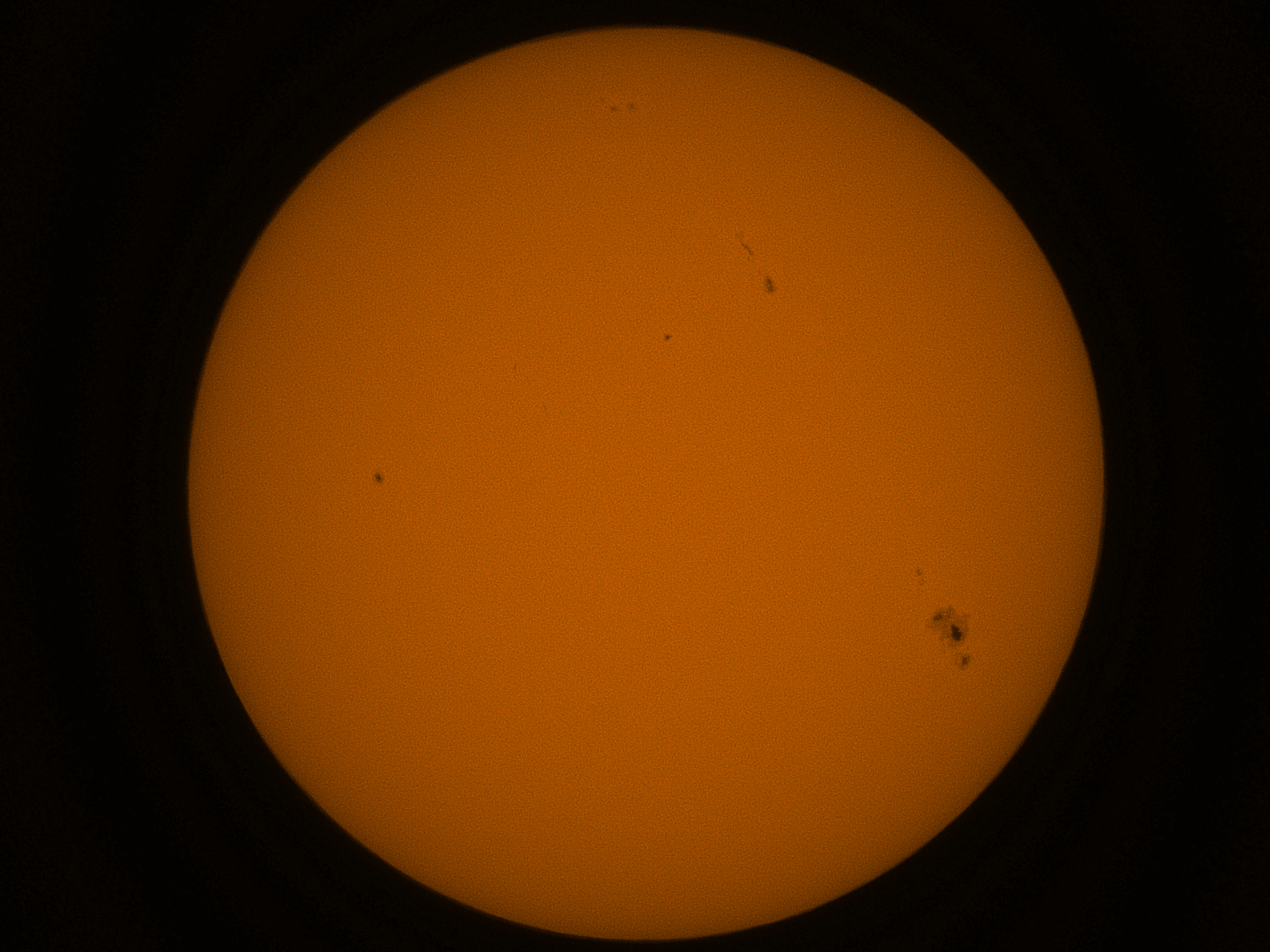
The active magnetic region where these flares were thought to originate can still be seen, and it is so large that it can even be caught by the naked eye (protected by a trusty pair of eclipse glasses). Below is an enhanced view of the Sun taken only six days later on February 27th with a UNISTELLAR ODYSSEY PRO, equipped with a solar filter. The culprit sunspot region, called AR3590, can be seen at around the 4 o’clock position . See our Unistellar help page for getting started with taking your own Solar observations.
Wrapping up
Our Sun’s solar cycle is a vibrant and interconnected process that ties us to the broader solar system. As we approach the cycle’s peak, increased solar surface activity will not only be observable but will also provide essential insights into our star. Even without specialized equipment, resources like SpaceWeatherLive.com allow everyone to partake in this momentous period of solar observation, celebrating our connection to the Sun in a significant year.