

There’s a new traveler passing through our cosmic neighborhood — and for the first time ever, citizen astronomers using Unistellar telescopes have captured it in action. Meet 3I/ATLAS (C/2025 N1), only the third confirmed interstellar object known to enter our solar system.

The orbit of 3I/ATLAS, which originated outside of the Solar System.
Another Messenger from Afar
Discovered on July 1, 2025, by the ATLAS survey telescope in Río Hurtado, Chile, 3I/ATLAS follows in the footsteps of its famous predecessors: 1I/ʻOumuamua in 2017 and 2I/Borisov in 2019. Like these earlier interstellar visitors, 3I/ATLAS is moving so swiftly and along such an extreme hyperbolic orbit that there’s no doubt it originated beyond our solar system.
In fact, scientists suspect 3I/ATLAS may have been traveling through the galaxy for longer than our Sun has existed, possibly ejected billions of years ago from a foreign star system. Now, it’s giving astronomers — both professional and amateur — a fleeting glimpse into the mysteries of other star systems. “Comets are windows into the early history of our solar system…but this interstellar comet offers a glimpse into the birth of another system,” says Dr. Ariel Graykowski, Postdoctoral Fellow at the SETI Institute and Unistellar’s lead Cometary Science Astronomer. “It’s a rare chance to see how ordinary or extraordinary our own origins really are.”
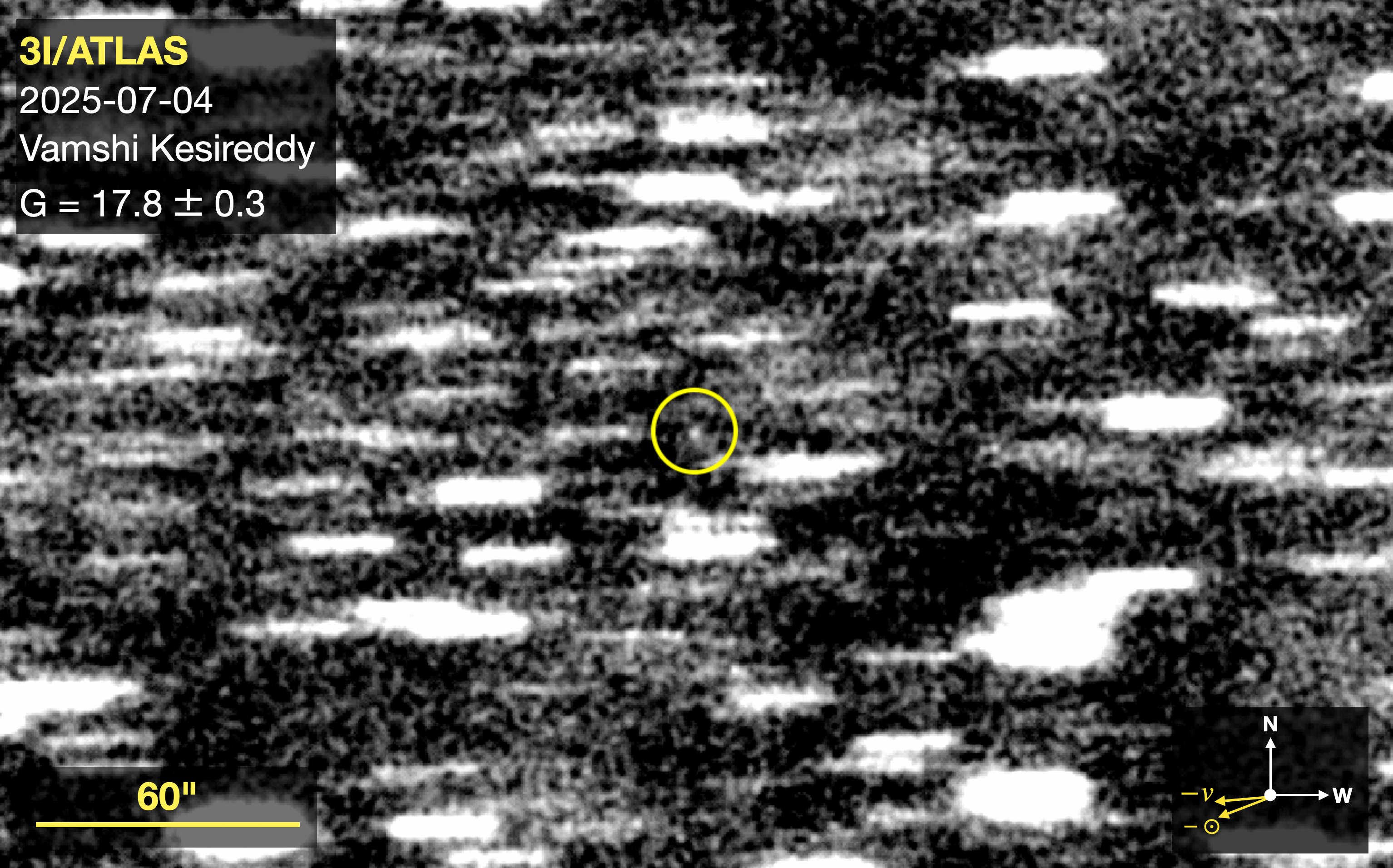
3I/ATLAS captured by Unistellar observer Vamshi Kesireddy (US)
3I/ATLAS Intruder Alert
Unlike 1I/ʻOumuamua, which showed no comet-like activity, 3I/ATLAS has displayed a visible coma and dust tail, earning it the official cometary designation C/2025 N1. Its activity so far appears to be dominated by dust rather than gas. Despite careful observations, astronomers have yet to detect any gas emissions such as CN or C₂ — signals that remain below the detection limits of ground-based telescopes.
As of mid-July 2025, 3I/ATLAS is about 3.4 AU from the Sun and heading for its closest approach on October 29, 2025, when it will pass about 1.35 AU from our star. Unfortunately, during perihelion, the comet will be too close to the Sun in the sky for observers on Earth to spot it. It’s expected to vanish into the Sun’s glare for nearly two months before emerging again for follow-up observations.
A Milestone for Citizen Astronomy
In an exciting first, the Unistellar Network of citizen astronomers has successfully observed 3I/ATLAS. On July 4th, Vamshi Kesireddy, one of our dedicated citizen astronomers, captured 3I/ATLAS using a Unistellar telescope. Thanks to his observation, Comet Lead Scientist Dr. Ariel Graykowski was able to measure the comet’s brightness at 17.8 mag — possibly the faintest object ever successfully detected by the Unistellar Network!
More Unistellar observers have also glimpsed the comet, but unfortunately the star-crowded fields that 3I has been traveling through made it impossible to extract a precise magnitude from their images.
Interestingly, 3I/ATLAS seems to be brightening more quickly than an average comet — behavior that hints it may be a dynamically new visitor, loaded with volatile ices being unleashed as it heats up for the first time in the inner solar system. At least, that’s what this phenomenon of brightening means for normal Solar System comets, but astronomers are still in the early days of tracking 3I’s activity. Follow-up observations will be essential for constraining its brightening curve and for better understanding the physical processes driving its activity.
“This time we’ve caught it early enough to coordinate observation campaigns with our Unistellar citizen science network and other citizen science telescopes to be able to capture images of it,” says Dr. Franck Marchis, Chief Science Officer of Unistellar and Senior Astronomer at the SETI Institute, noting how important these observations are. “Combining these observations, which allow us to track its trajectory, with those taken soon by major ground-based and space-based observatories could be a unique chance to study its composition and behaviour as it warms up while approaching the Sun.”

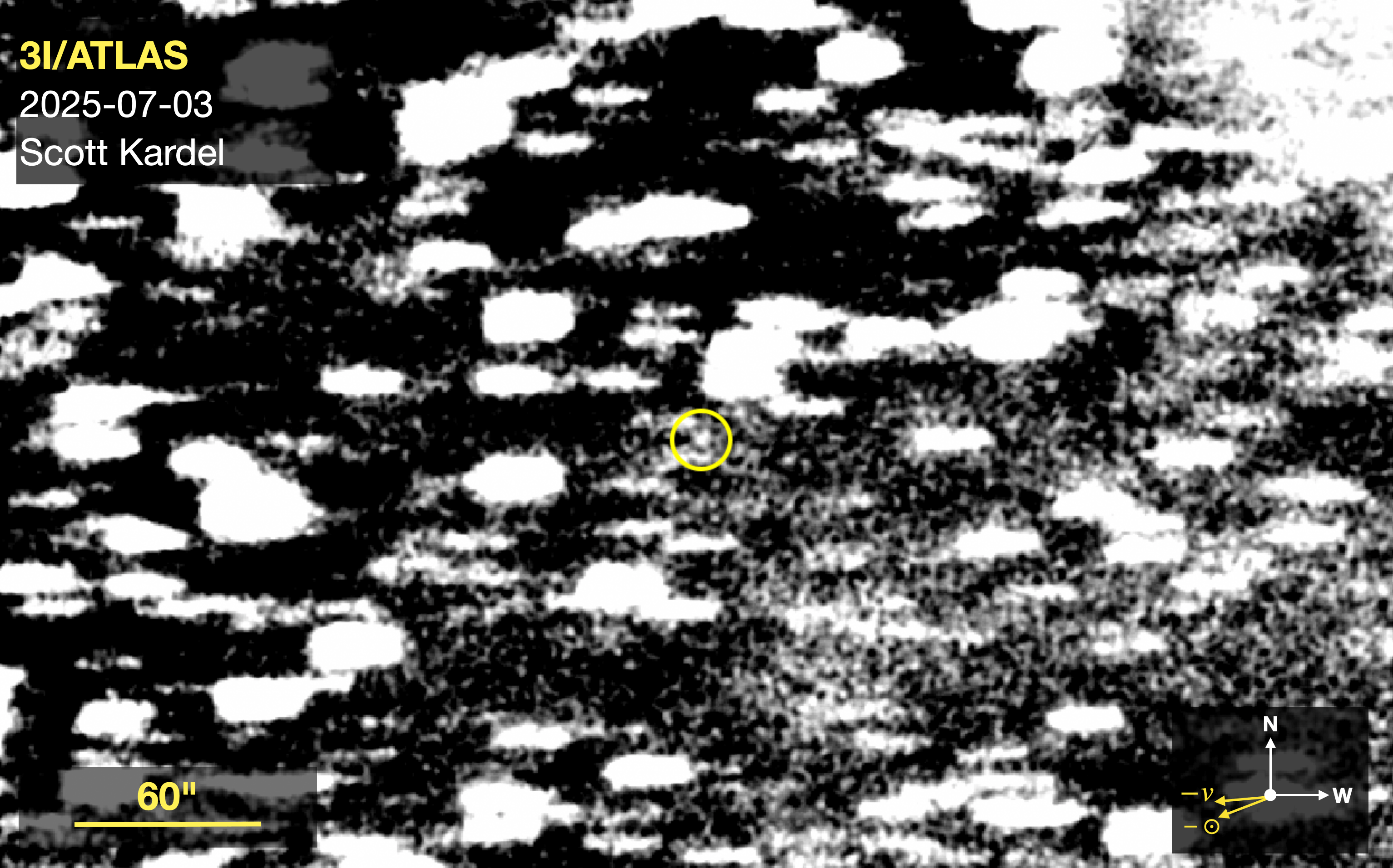
Observations of 3I/ATLAS by Bruno Guillet (France) and Scott Kardel (US). Unfortunately the crowded star field in these images prevented brightness measurements.
You Too Can Observe an Interstellar Object
Every interstellar object offers a rare chance to study material from another star system — clues to how planets and comets form elsewhere in the galaxy. By helping to monitor 3I/ATLAS, citizen astronomers are contributing valuable data that will help scientists understand the diversity of objects drifting between the stars.
With 3I/ATLAS racing toward the Sun and preparing to slip temporarily from view, the coming weeks are critical for gathering observations. That’s where you come in! Here’s how you can help astronomers study this cosmic interloper:
- Right now, 3I/ATLAS is visible to Northern Hemisphere observers. Make sure you catch a glimpse of 3I while it’s still visible!
- To make a Science observation, visit the Comets Tutorial Page and follow the Observation section instructions for B: The target is NOT in the Unistellar app’s catalog.
-
- In the Recording field be sure the following information is entered:
- Record duration : 40min
- Exposure time : 3791ms
- Gain : 25db
- When you are done, don’t forget to submit a Comet Observation Report.